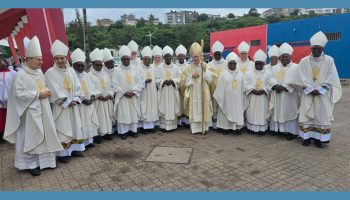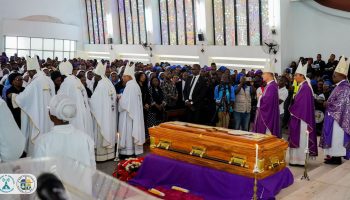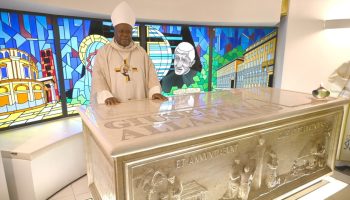
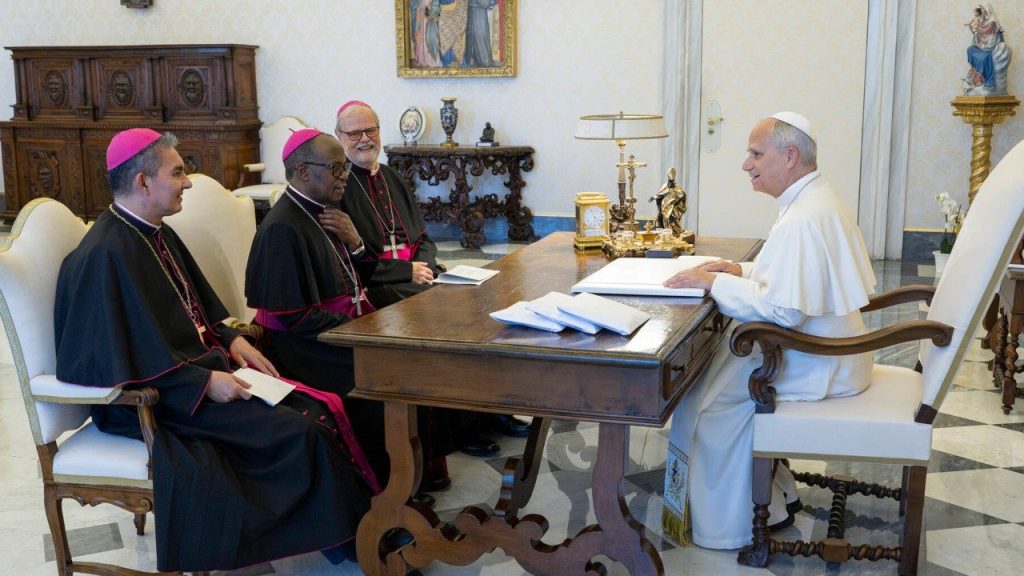
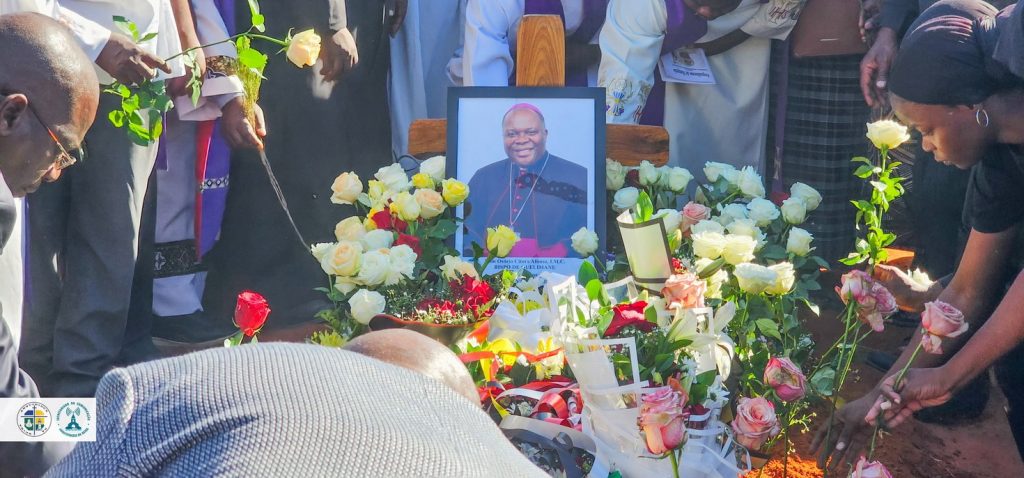
One month after the assassination of the Bishop of Quelimane, Msgr. Osório Citora Afonso, IMC, (54 years old), killed by gunshot in his episcopal residence on June 6, Mozambican authorities have still not provided any official information about the perpetrator, who ordered it, or the motives. With this concern in mind, the presidency of the Episcopal Conference of Mozambique (CEM) was received in audience by Pope Leo XIV on the afternoon of July 3, before his visit to Lampedusa.
By Jaime C. Patias *
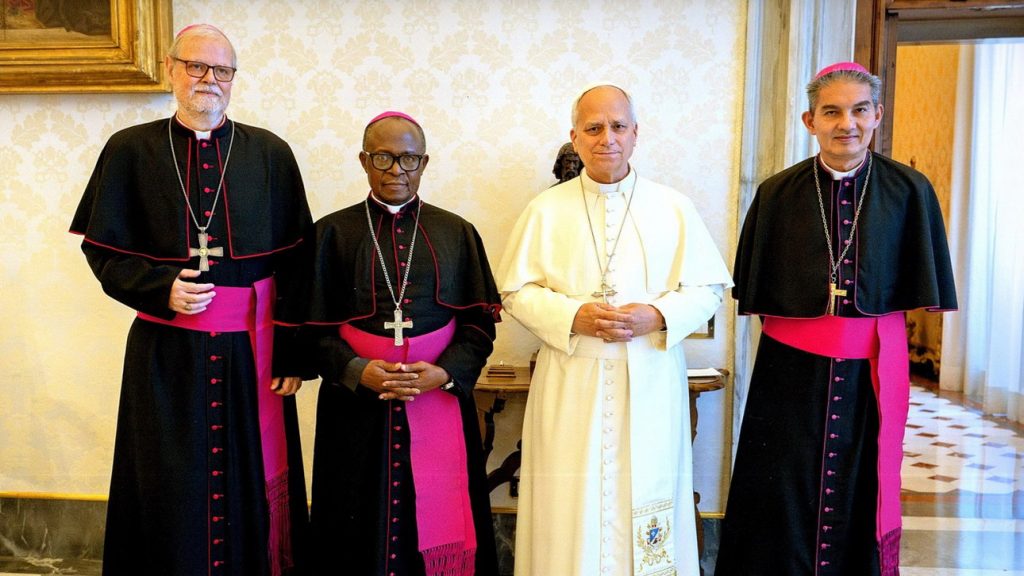
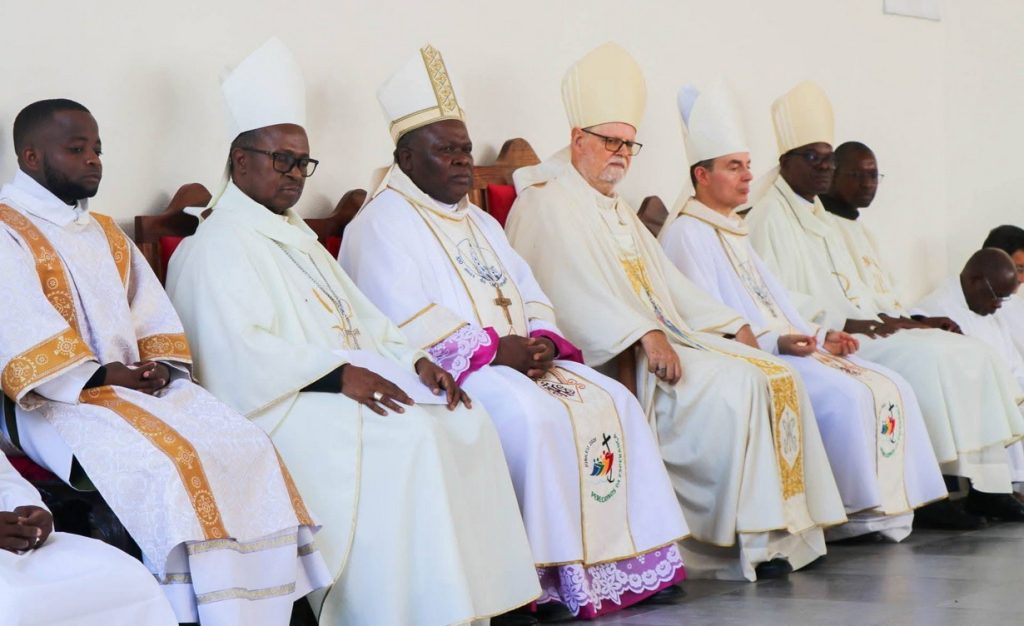
With the firm intent of “walking together in the search for truth,” present at the Apostolic Palace in Rome were Msgr. Inácio Saure, IMC, Archbishop of Nampula and president of the CEM, Msgr. João Carlos Hatoa Nunes, vice-president of the CEM and Archbishop of Maputo, and Msgr. Claudio Dalla Zuanna, SCI, Archbishop Emeritus of Beira.
“The visit to the Holy Father was our own initiative as an Episcopal Conference,” explains Archbishop Inácio Saure in an interview given to the Consolata News website in Rome. “We felt the Holy Father’s closeness at that time even though he was on an apostolic trip to Spain, yet we received a brief message of solidarity and encouragement,” the archbishop recalls. “We are concerned because since the news became public, we have received no official information about what happened, and we thought it would be appropriate to meet the Holy Father and be able to tell him directly the facts as they were reported to us and what we, as Church, perceive. It was a moment to share this pain with the Holy Father, to thank him for his closeness, and to present our understanding of the problem to him,” the CEM president emphasized in commenting on the visit.
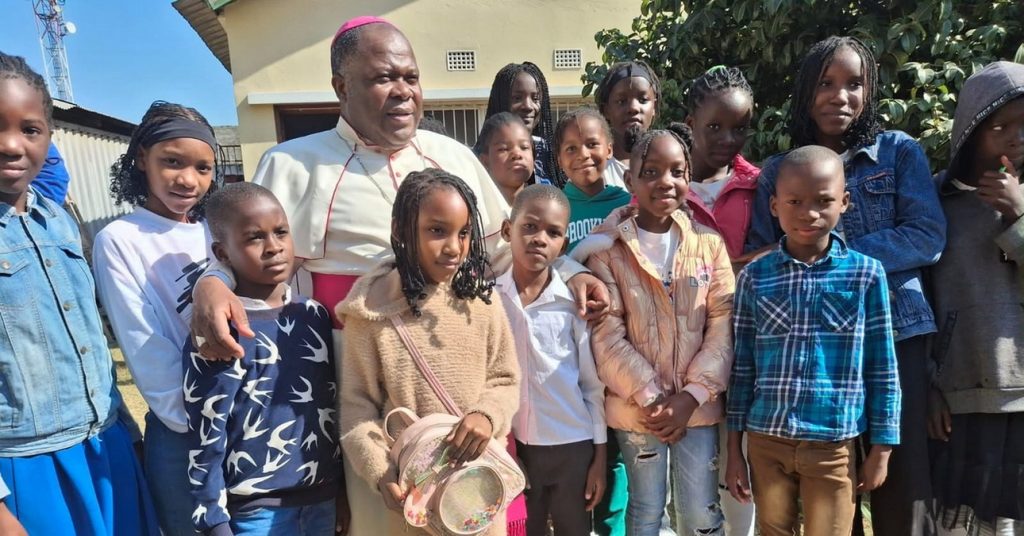
Solidarity and encouragement: a Church of martyrs
Archbishop João Carlos Nunes, in turn, recalls that “the loss of Bishop Osório shook the whole Church, and the pain touched everyone,” adding that he received these expressions of solidarity, but that for the Church a question always remains as to how this could have happened. “How is it possible that a pastor dies in the place we considered safest, his own residence? What happened and what led to this crime? There are many questions, and in the search for a word that might enlighten the people of God who are asking themselves these things, we felt it was appropriate to come to Rome to recount what happened and begin a discernment on the path to take to shed light on the reality,” observed Msgr. João Carlos, adding that he sensed the Holy Father’s great closeness to the Church in Mozambique. “He showed himself to be someone aware of the facts, who follows them, who is concerned about this event, and who wants the Church to undertake a path of overcoming, purification, and renewal. This is what we began in this meeting,” he emphasized.
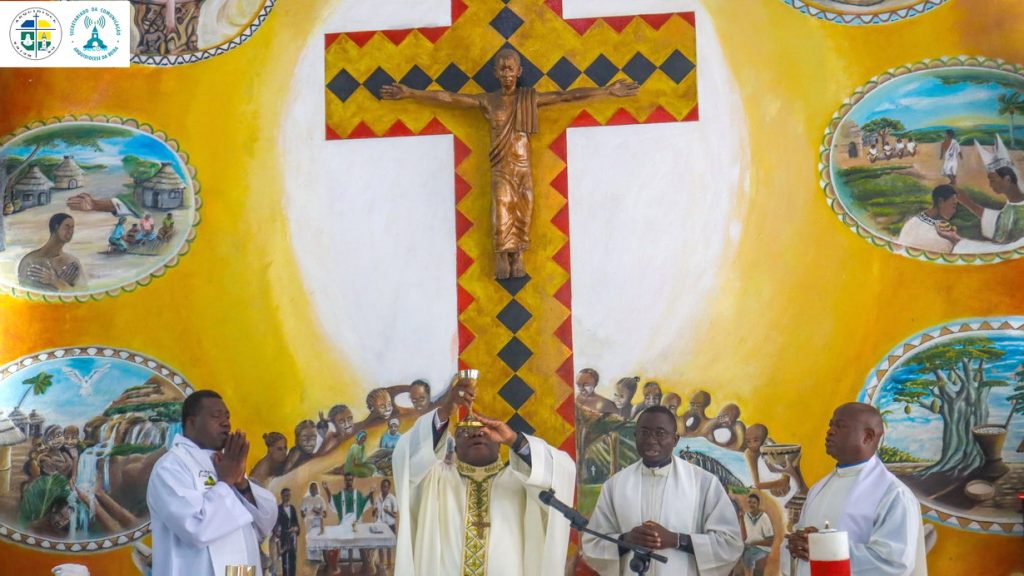
“Bishop Osório is a martyr of the faith”: renewal and purification
From the meeting with Pope Leo, the bishops return to Mozambique carrying with them “the certainty of his closeness and a word of encouragement,” reveals Msgr. Inácio. “To transform this moment of pain into a moment of renewal and to strengthen a suffering Church, a Church of martyrs. For me, Bishop Osório is a martyr of the faith,” states the Consolata missionary archbishop.
The Holy Father asked the bishops whether they believed there was still hope that the truth about what happened could be revealed. “We answered yes. So we are counting on the Holy Father and on the Church, so that there be no silence and the truth be told. And that this be a favorable moment for the renewal and purification of the Church,” emphasizes the Archbishop of Nampula.
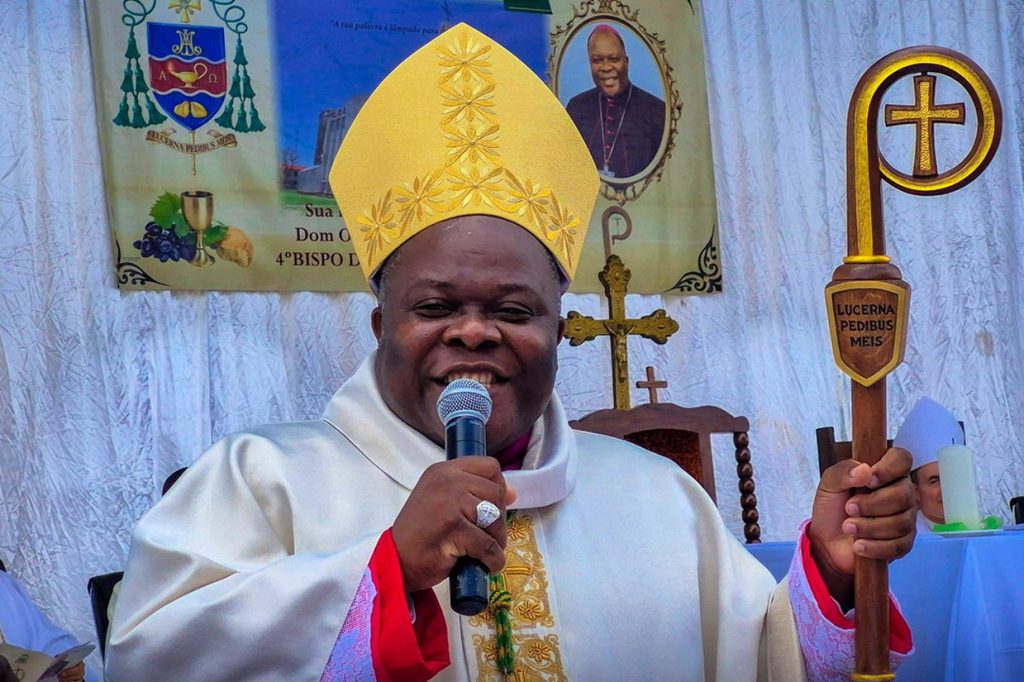
“A missionary devoted to the Gospel, a man of God”
A native of Ribaue (Nampula), Bishop Osório Afonso was a biblical scholar and an official at the Dicastery for Evangelization in Rome from 2017, until he was appointed Auxiliary Bishop of Maputo on September 21, 2023. He received episcopal ordination on January 28, 2024. On July 25, 2025, Pope Francis appointed him Bishop of the Diocese of Quelimane. On April 10, 2026, he was also appointed Apostolic Administrator of the Archdiocese of Beira and, at the same time, held the position of Secretary General of the Episcopal Conference of Mozambique (CEM). For years he collaborated with our website Consolata.org, where he published reflections on the Sunday liturgical readings.
Msgr. João Carlos lived with Bishop Osório in the Archdiocese of Maputo (2024). “He was a missionary passionate about the mission, who devoted himself to it body and soul,” he emphasized. “Perhaps that’s why he suffered this tragedy. He never accepted injustice and reacted when he saw something was not right, when transparency was lacking. He did not accept it and did not tolerate it. He was a missionary devoted to the Gospel.”
His confrere, Msgr. Inácio Saure, says he had known Osório since the 1990s. “We met in seminary, and I welcomed him as a younger brother, and we walked the path of formation together for a long time. I always saw in Osório a man of faith, so much so that, in the face of difficulties, he never became discouraged.” This was shown when he was appointed Bishop of Quelimane, a diocese that had long been without a bishop after the resignation of Msgr. Hilário Cruz Massinga, OFM, from governing the diocese in 2023. Finding a bishop was difficult, and so Msgr. Osório was aware of the difficulties, “yet he accepted.” Indeed, “listening to his homilies, one could tell that he was aware of the difficulties, but was not afraid to face them in the light of faith. For me, Bishop Osório was truly a man of God,” emphasizes Msgr. Inácio Saure.
Challenges for the Church’s mission in Mozambique
The bishops share some concerns regarding the country’s context, which posed a challenge not only for Msgr. Osório’s mission but for all pastors in general. According to Archbishop João Carlos, a first challenge is “the trivialization of life. The tendency to solve problems by eliminating the other.” In Mozambique, “intolerance is a reality. This affects every pastor, and I believe he experienced it too,” observes Msgr. João Carlos, continuing: “The proliferation of weapons. The country has gone through various situations of war. There was a weapons collection program, but there are still many scattered around.” Another challenge is “the loss of values and corruption as a way of life, as a method for solving problems. All of this is part of the social context on which, on various occasions, the Episcopal Conference has written letters.”
According to the Archbishop of Maputo, the assassination of Msgr. Osório “invites us to look within the Church, at the weaknesses we face — for example, the lack of coherence between what we preach and beautiful celebrations, but then in life this lack of coherence shows itself,” he denounces. “Certainly this is the context in which Msgr. Osório lived and which contributes to creating unease in those who want to maintain this lifestyle that is against the Gospel. And he, as a man of the Gospel, had to confront a system, forces of evil,” emphasizes Msgr. João Carlos.
Msgr. Inácio Saure completes the picture of difficulties. “In the dioceses we have the problem of lack of resources. This poverty is an evil that crushes the Mozambican people, crushes most of our faithful and consequently the churches. It is not easy to lead a diocese amid all these economic difficulties that also affect the life of the clergy, often weakened by this poverty, and if one is not very strong, one can be led by those who have money, letting oneself be manipulated instead of focusing on one’s mission as pastors,” he states.
Msgr. Inácio Saure based this on a homily in which Msgr. Osório made an appeal: “we cannot make the Church a place of business,” and this shows the existence of the problem in Quelimane. “Therefore, it was one of the difficulties he faced.” In addition, Msgr. Osório was also concerned about the qualification of the clergy and was beginning to organize the specialization of some priests abroad as well as diversify the formation paths for seminarians.
Urgent need to shed light on those who carried out, ordered, and had motives for the crime: may the truth prevail
“A month after the event,” observes Bishop Inácio Saure, “no official information has been provided beyond the initial confirmation that the bishop was killed with a firearm — not just any pistol, but a war weapon (of the AKM type, as initially revealed by the spokesperson of the National Criminal Investigation Service) which, in Mozambique, is normally in the possession of the authorities, state security agencies, and the armed forces,” the CEM president emphasized. “Who shot the bishop? This is another question that news outlets have never answered,” observes the archbishop.
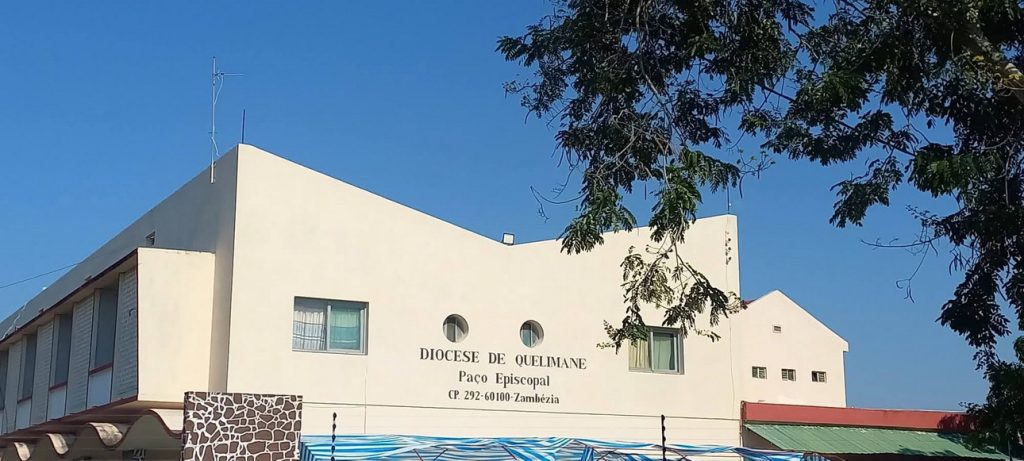
Msgr. Inácio Saure recalls that they immediately arrested the former chancellor of the Diocese of Quelimane, Father Adelino Novais Amado, considered one of the suspects, and later also Father Celso, for reasons known to them (they also arrested, and then released, a guard and the gardener). The computers and cell phones of Bishop Osório and of the apostolic administrator of the diocese, Msgr. Estevão Ângelo Fernando, were seized. All of this points to a line of investigation. “But who ordered the crime?” According to Bishop Inácio, no one answers this question. “There seems to be a certain partiality, both in the investigation and in the publication of information.”
The newspapers highlight the arrest of a priest, accusations of irregularities raised by the apostolic administrator, and news leaks. The proliferation of speculation is hindering the establishment of the crime. “Ultimately, nothing is said. This is our great concern: wanting to take one side and leave out the other, perhaps deliberately, even if it is no less important. We want the truth about who killed the bishop. I cannot in any way absolve the suspected priest, but it is very unlikely that one of those priests fired at the bishop. Who ordered the murder? And what were the motives? These are the questions that need to be answered,” maintains Bishop Inácio.
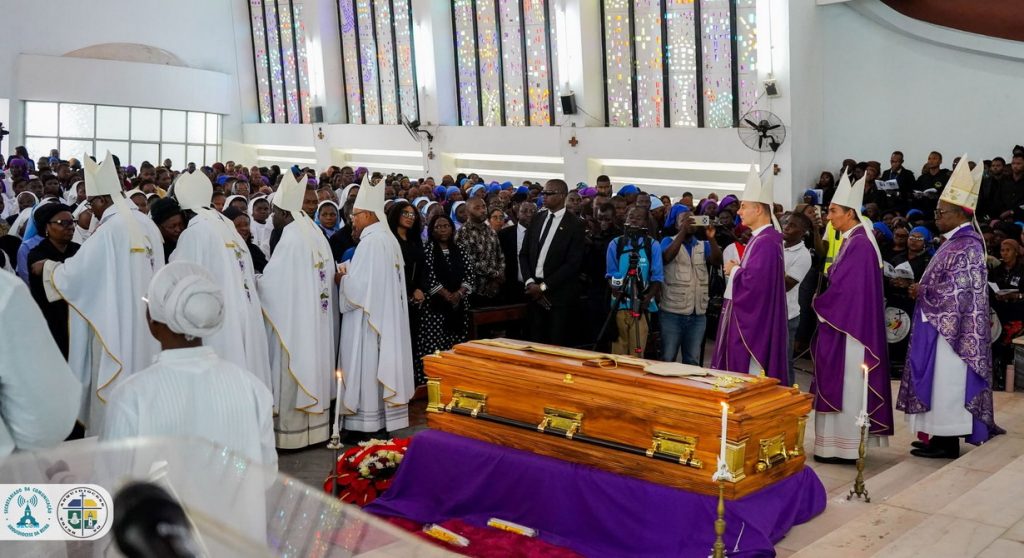
Msgr. João Carlos explains that, regarding the investigations, the bishops of Mozambique have set out on a path. “We leave Rome with the conviction that we will not walk alone. We walk with the universal Church, with the Holy Father, and with all people of good will,” he emphasizes. In addition to the audience with Pope Leo, the CEM bishops met with the Secretary of State, Cardinal Pietro Parolin, where “a commitment was made to walk this path together.” The Archbishop of Maputo reveals that Cardinal Parolin sent a letter to the President of the Republic of Mozambique, Daniel Francisco Chapo, expressing the hope that “the authorities seek the truth seriously and responsibly and that, with due discretion, this be shared with the bishops of the CEM. We believe the truth will prevail,” states Bishop João. On one hand, the bishops ask for this common path, and on the other, they ask the people to continue praying and to have faith. “Msgr. Osório wanted the best for the Church, and it is necessary to continue this legacy. He died in his mission, and this is what we should all carry with us and commit ourselves to in the search for truth,” reaffirms Msgr. João Carlos.
Msgr. Inácio Saure adds that, “despite all the darkness, there is a small light at the end of the tunnel,” and reveals that a plenary assembly of the CEM will soon be held to study the problem together, given that after the event only one meeting of the Permanent Council has been held.
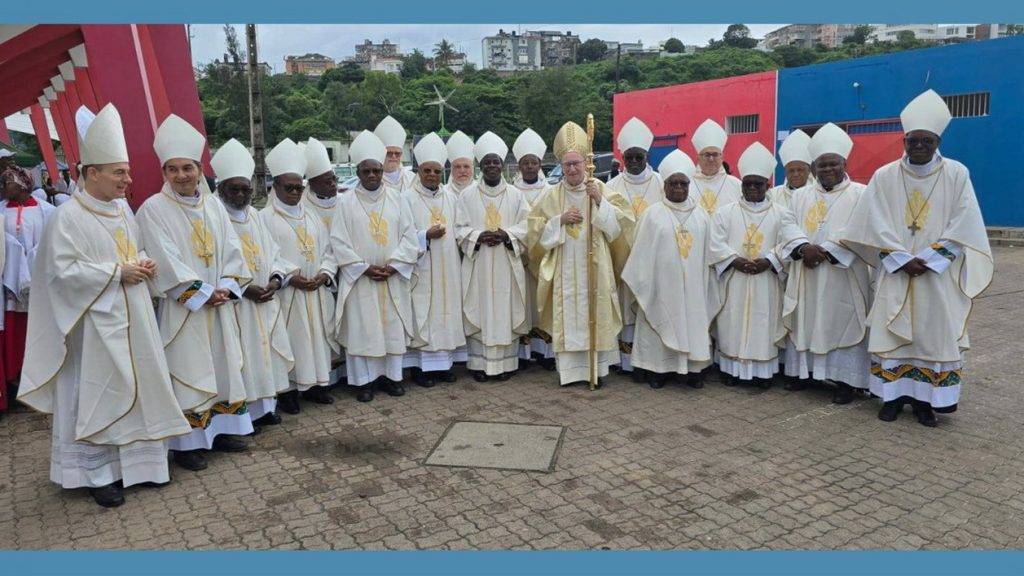
Faith and courage: a Church of martyrs is a strong Church
The bishops, president and vice-president of the CEM, concluded the interview with a message of hope. “May this event be a moment of strengthening in faith. As I said, Bishop Osório Afonso is a martyr of the faith, and a Church of martyrs is a strong Church. History shows that the Church’s strength lies in martyrdom,” concludes Msgr. Inácio.
“What we want to say is: courage,” states Bishop João Carlos, warning against two extremes: “on one hand, falling into the trap of thinking that this is just another event to be forgotten, as has already happened in our country’s history, but also avoiding the other extreme, which is the politicization of the issue. What we must do,” inists the CEM vice-president, “is to look with faith at the examples and commit ourselves to walking together in the search for the truth that sets us free. And above all, to continue the legacy that Msgr. Osório left us,” he concluded.
* Father Jaime C. Patias, IMC, Communications Office.