In the field of Christian Spirituality, there is a course called spiritual seeing. This course is often rooted in Orthodox iconography and teaches that Icons are not merely art but windows into heaven that are written (painted) to be read.
By Orero Charles *
Therefore, the course helps interpret icons by teaching the viewer to look beyond the two-dimensional, non-realistic style and to understand the symbolic language of colour, gesture, and light.
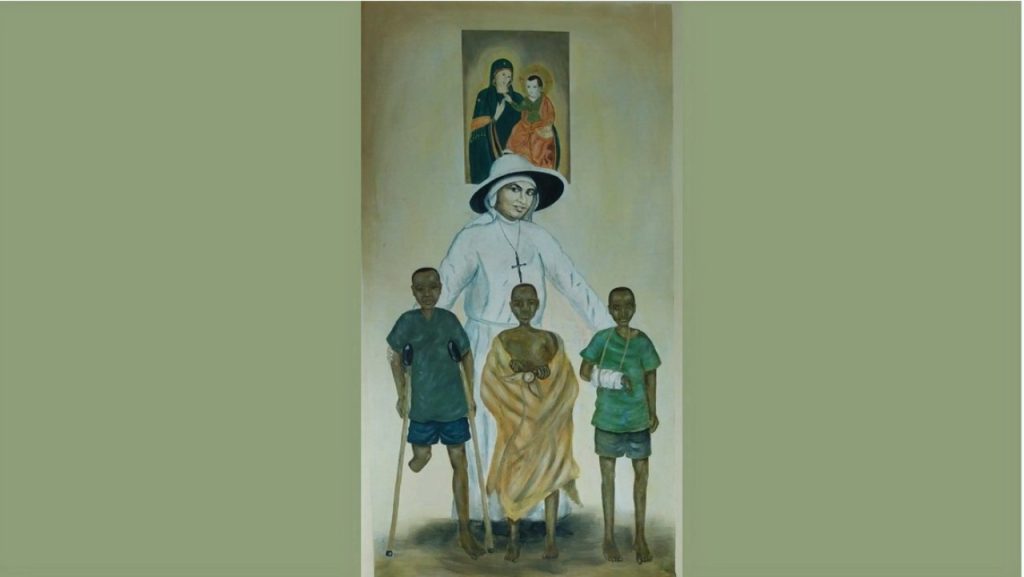
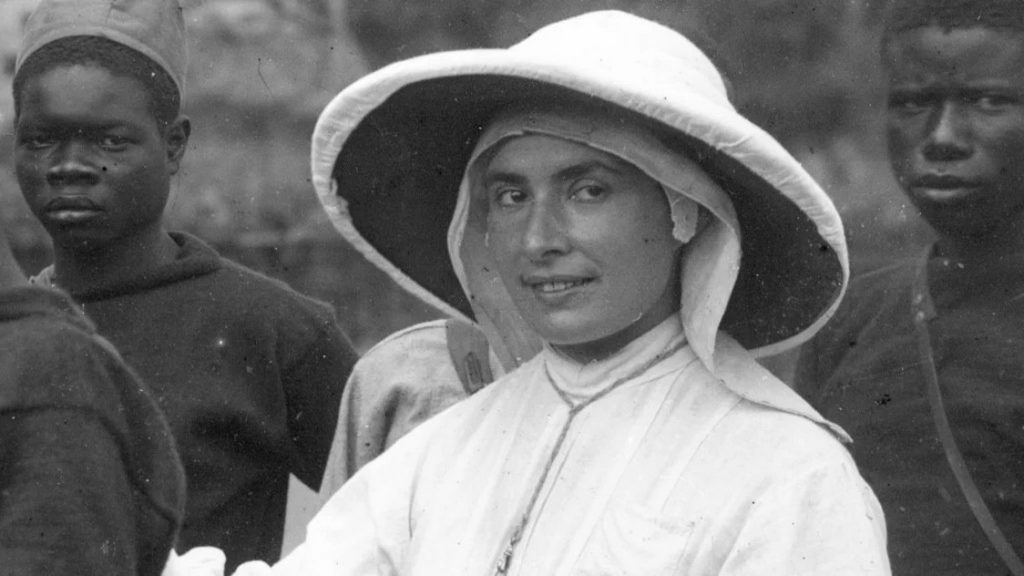
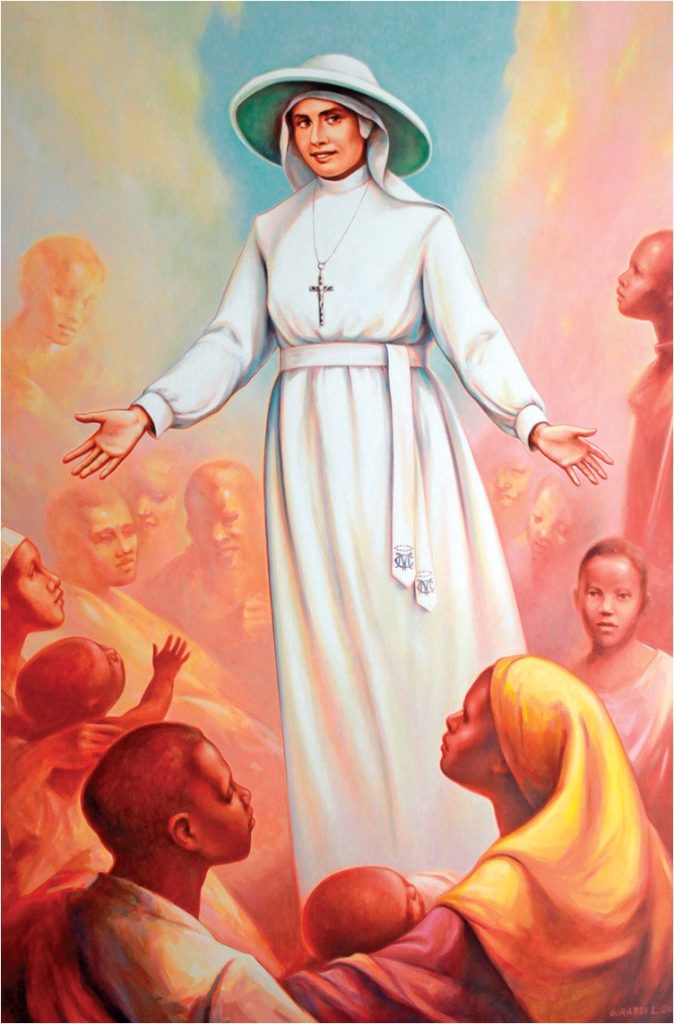
Using the techniques of this course, I would like to give a spiritual interpretation of the above painting of Blessed Irene Nyaatha (1891 – 1930), a Consolata missionary, beatified under the pontificate of Pope Francis on 23 May 2015.
In the above painting, we encounter the following:
1. Icon of our Lady Consolata
The Icon of Our Lady Consolata is put right on top of the whole painting, and looking at it keenly, it is in contact with the Cap Blessed Irene is wearing. Why is this Icon put rightly on top, and why is it in contact with Irene’s Cap?
Our Constitutions make us consciously aware that: ‘’ we are called ’Consolata’ after Our Lady of Consolation and that we share in Mary’s motherly mission to take to the World, Christ our Saviour, the true Consolation.’’
Therefore, in our missionary apostolate, Mary remains the model and the fountain from where we draw our inspiration. Consequently, Mary is placed on top of the Image to indicate that she is the source and origin of all that Blessed Irene does.
In addition, the contact between her and Irene is a symbol that, from her, flows the consolation that Blessed Irene will take to the People.
2. The Image of Blessed Irene
To begin with, the image of Irene is more conspicuous, bigger than all other images, and placed right at the centre of the whole painting. Why?
This is because she is our centre of attention; she is the focus. Irene is putting a white Cap painted black inside. There is a cross hanging on her chest. Her two hands are touching two boys. Her eyes are not looking at the three boys; they are focused ahead. What do all these communicate to us spiritually?
The Cap : The cap Irene is putting on takes the shape of an umbrella. Inside, it is painted black. An umbrella is meant to protect a person from the hot sun or rain.
This means that the Consolation that emerges from Mary through Irene to the people was indeed a protection against every form of the rain and the heat of human suffering.
It was an antidote against illness, poverty, ignorance, hopelessness and every other catastrophe besetting human life.
Inside the cap is painted black; to symbolise that, the darkness of human suffering was being overcome by the power of Mary’s consolation through her.
The eyes of Blessed Irene: The eyes are looking in front rather than at the three boys next to her. This shows that she is aiming ahead at a bigger mission than what she has already accomplished. In other words, like Jesus Christ, she must go on to the neighboring villages to take God’s Consolation there as well, for that is why she became a missionary and was sent. (Mark 1:38) Therefore, with Saint Paul, Blessed Irene can say: ‘’ not that I have already obtained all this, or have already been made perfect, but I press on to take hold of that for which Christ Jesus took hold of me’’ (Philippians 3:12).
The cross hanging on her chest: This cross is a symbol of sacrifice and self-giving, for the mission, bearing in mind the words of Our Founder, Saint Joseph Allamano: ‘’It is through the cross that we sanctify ourselves, not through words and simple prayers, and the true path that leads to heaven is and always will be that of the cross.’’
Therefore, with Saint Paul, Irene can again exclaim: ‘’I have been crucified with Christ, and I no longer live, but Christ lives in me. The life I live in the body, I live by faith in the Son of God, who loved me and gave Himself up for me.’’ (Galatians 2:20)
Irene’s hands: Irene’s hands are touching the two boys standing on her left and right sides. This touch is a symbol that the mission must go beyond simply delivering a message to deeply understanding, sharing in, and responding to the daily lives, culture, and struggles of the local community.
Three boys: standing in front of Irene are three boys. The boy standing at her left hand has the left leg amputated. The other boy standing to her right seems to have a broken hand.
The two boys are symbols of human physical suffering, which needs a healing touch from a missionary of Consolata.
The faces of these two boys are imbued with smile, meaning that, in their suffering, they are not alone; there is someone assuring them that there is a new dawn in the offing. It is as if through Irene, God has spoken to them the prophetic message of hope : ‘’ So do not fear, for I am with you; do not be dismayed, for I am your God. I will strengthen you and help you; I will uphold you with my righteous right hand. (Isaiah 41:10)
The boy standing in the middle has his chest exposed. His garment is traditionally made, and his hands seem tied. Below his tied hands, there is an object that seems to have tied his hands. This boy is a symbol of a person submerged in superstition.
The presence of Irene is already the beginning of removing this garment of superstition. The cross is rightly placed on his head. This cross is a symbol of the ultimate, finished work of Jesus Christ, breaking the chains of evil, sin, and spiritual bondage, offering liberation from fear and demonic oppression.
* Father Orero Charles, IMC, a Consolata missionary working in Tanzania.